In this guide
A suitable repair needs sound surrounding material, compatible products and the right application conditions. If the deck or wider roof is failing, another surface patch may be poor value.
Where flat roof leaks often need investigation
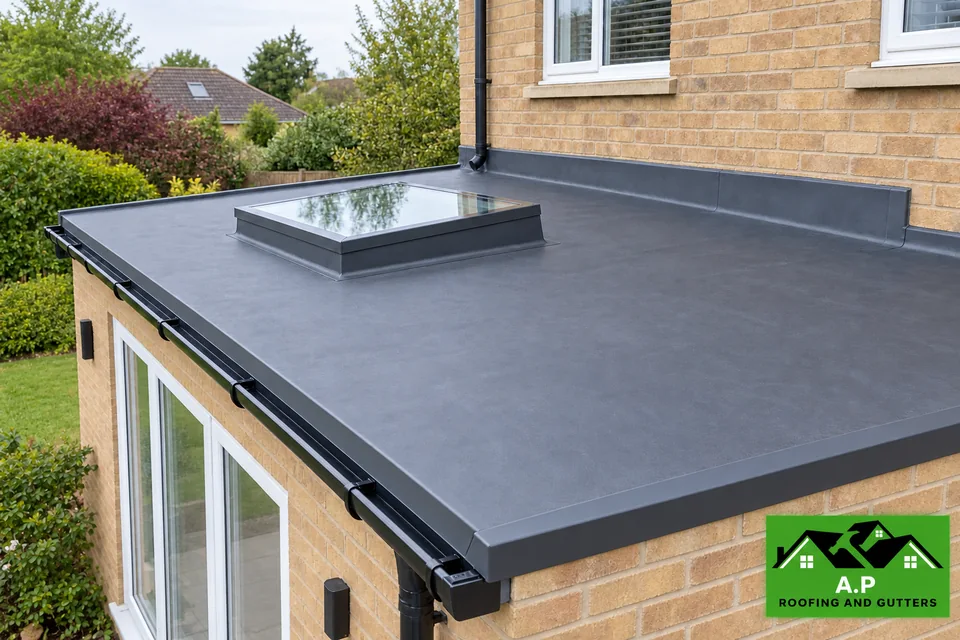
Tell the roofer about the covering if you know it: felt, EPDM rubber, GRP fibreglass or another system. If you do not, a safe photograph or previous paperwork may help. Different materials need different repair methods, and a product that suits one roof may not suit another.
- Outlets and gutters: water needs a clear, properly formed route off the roof.
- Wall junctions: check the upstand and the weathering that connects the roof to the building.
- Rooflights: the kerb and surrounding covering matter as well as the glazing.
- Perimeter edges and seams: lifting, movement or local damage can admit water.
- The deck below: a surface repair cannot restore weakened support.
What standing water does and does not tell you
Some water may remain briefly after rain. Persistent ponding, a new low spot or a change in how quickly the roof clears deserves assessment, but it does not identify the leak on its own. The roof’s falls, outlet positions, deck and covering need to be considered together.
Do not poke holes in a membrane or try to create a new drainage route yourself. Nor should a roofer simply cover a low area with another layer without explaining why it formed. A drainage defect and a failed waterproofing detail can be related problems requiring different parts of the repair.
Why water can appear away from the defect
Water can travel within the roof layers and emerge where it finds an opening below. A ceiling joint may be the exit point, with the entry at the opposite edge of the extension. Damp close to the house can also involve the adjoining wall or flashing rather than the open roof surface.
Describe whether the leak appears quickly, only after prolonged rain or during wind from one direction. Note any recent work around rooflights, aerials or the adjoining wall. Those observations are useful when the roof is dry at the time of inspection.
The winter challenge is the repair conditions
Cold, frost, moisture and shorter dry periods can limit how repair materials are prepared and applied. Adhesives, primers, resins and coatings have product-specific instructions. There is no single temperature rule that makes every flat roof repair suitable.
The contractor should select a method compatible with the actual covering and check the surface conditions and forecast. A patch that appears attached at the end of the visit may still fail if it was applied to an unsuitable or damp substrate. Where conditions prevent reliable permanent work, discuss deliberate temporary protection and a follow-up plan.
When a local repair makes sense
An isolated puncture, open seam or failed detail can sometimes be repaired if the surrounding system is sound and the damage can be prepared properly. Ask how the repair will join to retained material, what area is included and whether the substrate needs checking.
Repeated splits, widespread failure, a soft deck or trapped moisture may make a larger scheme more sensible. Replacement should still be supported by evidence. Compare the expected outcome of the local repair with the proposed wider work, rather than assuming either the cheapest patch or a new roof is automatically right.
Before and after the visit
Keep clear of the roof, including low garage roofs that look easy to reach. Surface condition does not prove that the structure below can carry you. Indoors, move belongings only where safe and avoid the area beneath a bulging ceiling or water near electrics.
After a repair, keep photographs and the agreed scope. Ask about drying, the temporary or permanent status of the work and any monitoring needed. Internal damage may need separate attention. If fresh water appears, record when it happens and contact the roofer before adding another coating.
AP Roofing provides flat roof repairs in Crawley for extensions, garages and other suitable roof areas. We can explain whether the problem appears local, whether opening up is needed and what conditions the repair requires. If you are comparing systems, our EPDM, GRP and felt guide is a useful next read.
Questions worth asking
Can a flat roof be repaired in winter?
Often, but the method and timing depend on safe access, the covering, substrate condition and the instructions for the materials used. Some permanent work needs a suitable dry-weather window.
Does ponding mean the membrane has failed?
Not by itself. Persistent or new ponding needs investigation of drainage and support as well as the covering. The leak may be at a connected detail.
Should I paint the whole roof with a waterproof coating?
Only if a specified system is suitable for the roof and its condition. A general coating can conceal defects, be incompatible or leave drainage and deck problems unresolved.
Discuss a flat roof repair
Tell us what you have noticed and where the property is. We will discuss the next step and a free estimate for the roofing work.
Explore the repair service ↗General guidance for homeowners. The right repair depends on inspecting the individual roof. Keep checks at ground level unless there is safe, suitable access.